
Cumberland Arrest Reports Have No Blotter
The Cumberland County Sheriff's Office posts no dated booking log. There is no weekly batch or weekend roundup. No roll-off rule or archive depth has been set out for Cumberland County arrest records. No universal blotter fields exist either. The Active Inmate Lookup is a current-custody tool. Someone booked into the detention center and later released can vanish from that roster. Agency and court records still hold the arrest. So record type comes first. An incident report covers a reported event, and a booking record covers jail intake. A court docket tracks hearings and disposition. None of the three can stand in for the others.
Read Cumberland Arrest Report Entries
Start with what the source itself calls the record. A press release or incident-search hit is not a booking entry, so one sequence works best for any multi-day inquiry.
- Search the official CCSO Reports Center by a known date, street, offense, subdivision, or OCA/incident number.
- Check Fayetteville Police media releases or P2C when Fayetteville officers handled the event.
- Use the active inmate roster only to test present county custody, not past custody.
- Check the North Carolina court portal for the filed case, hearings, and later disposition.
- Ask CCSO Records Management or the arresting police agency for the specific arrest, incident, or booking record beyond public online windows.
Neither Hope Mills nor Spring Lake posts a full online arrest blotter. Their records desks keep those reports in hand. Same-day searches are handled separately on Arrested Today.
Cumberland Report Fields Compared
Fields change with the system. The table shows what each source can establish, without promising that every record discloses every item.
| Source | Useful fields | Not established |
|---|---|---|
| CCSO Reports Center | OCA or incident number, offense, street, date, subdivision | A complete jail booking history |
| Active Inmate Lookup | Name search and live returned custody details | All arrests during a past week |
| FPD release | Release date, event narrative, alleged charges, sometimes bond or appearance details | Every Fayetteville arrest |
| Court portal | Case summary, actions, calendars, hearings, disposition path | Present jail custody |
| Records response | Whatever releasable responsive booking or incident material the custodian holds | Protected investigative information |
Under N.C.G.S. 132-1.4, specified arrest and law-enforcement information may be public while investigative details or protected material can remain limited. Ask the custodian to explain a denial or redaction rather than inferring that a missing item never existed.
Seven Years of Cumberland Incidents
The CCSO Reports Center reaches back seven years of incident and crime data. That reach is deep. Searches run by OCA or incident number, offense type, street, date, or subdivision. Separate tools cover crime statistics and civil records. So it can tie a known Cumberland event to the sheriff's record system.
It is not a booking archive. Seven years of incident reports do not equal seven years of Cumberland County mugshots. They do not equal seven years of jail entries either. A match there describes an incident, not an in-custody person. For current detention, the active roster answers. Case outcomes live in the Judicial Branch portal.
The official Reports Center page shows the multi-field search you would use for older dates.
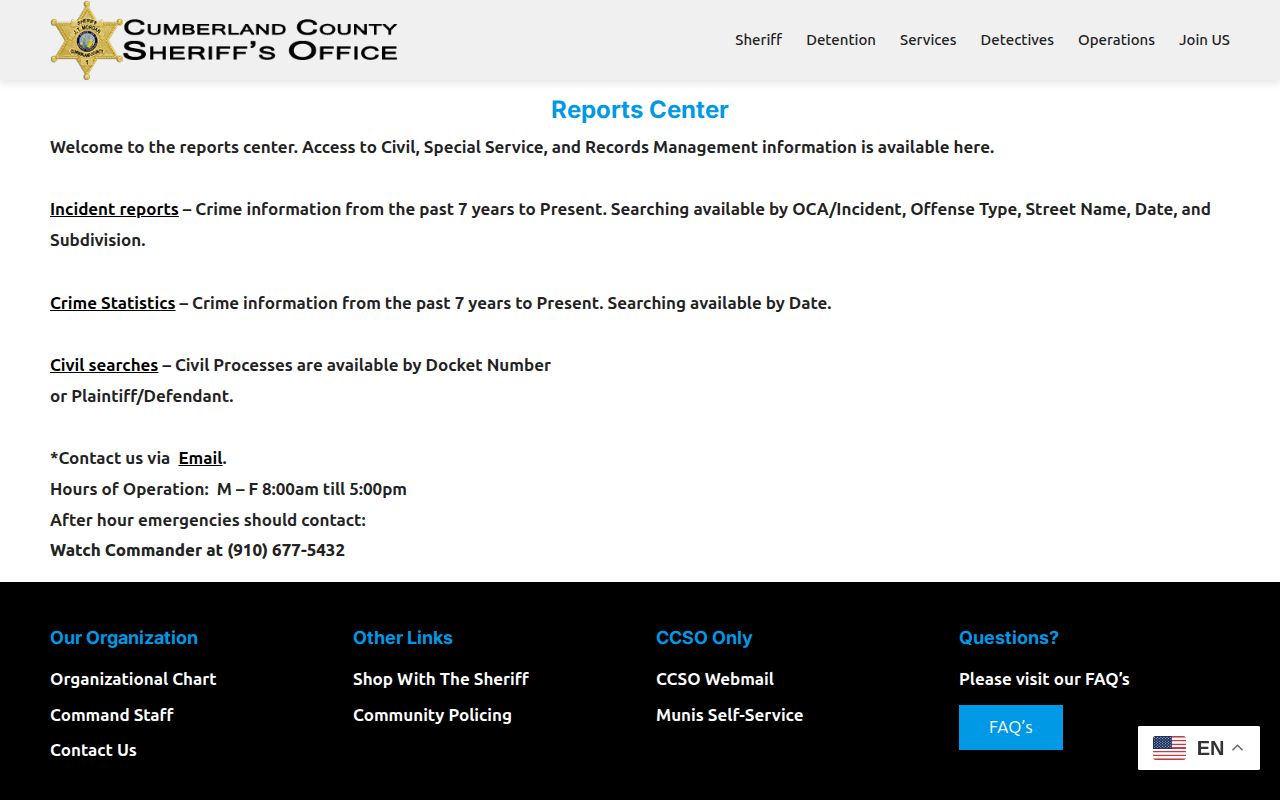
That view helps you pick the right record search rather than mistaking it for a booking-photo archive.
Fayetteville Arrest Reports Split Sources
Fayetteville splits its arrest information across two systems. The FPD Media Releases archive is dated and searchable. It also pairs with P2C event and report tools, so a police event or a chosen arrest announcement can be documented. Detention is a different question. CCSO's Active Inmate Lookup answers it, and neither system posts on a shared schedule. The city's media release page shows the event-driven channel itself.
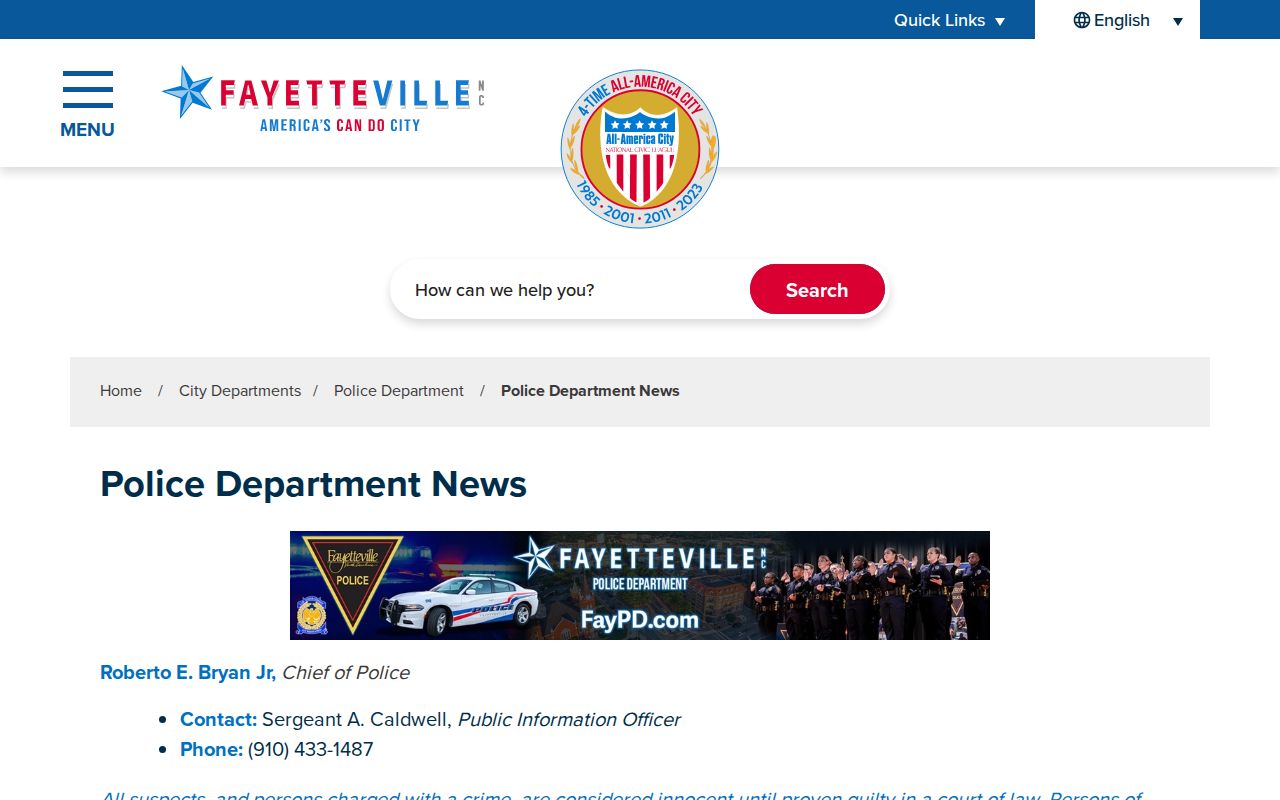
Each release covers a single case that caught the city's attention. It is not a full Cumberland County booking list. Charges, bond amounts, first appearances, and case details may all appear. An agency photo sometimes rides along. Timing matters too. The moment a release goes out has nothing to do with when the person was actually arrested. No release tells you how the case ended in court.
Cumberland Arrest News Is Selective
News coverage helps once you have worked the official sources. The Fayetteville Observer, ABC11, WRAL, and CityView NC all run selected crime and arrest stories. Each is tied to Cumberland County. They publish when something happens. None serves as a daily or weekly booking blotter. A picture attached to a story can be a scene shot, an editorial image, or something an agency handed over. It may not be a mugshot. The Fayetteville Observer crime section is one good stop for notable arrests and follow-up reporting on how cases develop.
News stories add color, but they cannot promise full coverage of Cumberland arrests. Once the official paths are exhausted, four county sections offer copied booking entries: BustedNewspaper, Mugshots.com, Arrests.org, and Mugshots.zone. Treat all four as unofficial. Entries can sit untouched for months. They may carry wrong details, or miss a dismissal that came later. RecentlyBooked lists no live Cumberland page. Do not settle for some other county's list. The sheriff's office, the arresting agency, and the court still have the final word. The layouts differ from site to site. BustedNewspaper paginates its results. Mugshots.com lets you browse by historical arrest date. It also tags entries with Fayetteville, Hope Mills, or Spring Lake. Arrests.org groups pages by date, and Mugshots.zone sorts entries by archive month. Those are just copied archive formats. They are not arrest totals. They are not proof of complete coverage, or a sign that any entry is still current.
Cumberland Weekend Report Gaps
Cumberland County has no official multi-day blotter. That makes weekend pattern claims impossible to back up. A Monday cluster of arrests might mean real weekend activity, slower processing, delayed releases, a newsroom's own schedule, or a copied site refreshing its feed. None of that supports calling it a county trend. The CCSO Reports Center does allow date searches, and the office posts crime-statistics functions too. But those are incident datasets, not jail booking totals. Any honest trend analysis has to name its dataset, its date range, its geography, and its limits.
Request Older Cumberland Arrest Reports
Start with a question when the online entry vanishes. Ask CCSO whether the record still sits in Records Management, moved to another county office, or became eligible for archival transfer. North Carolina records schedules govern retention and lawful disposal. A schedule alone never proves a booking photograph survived. State Archives box lists and its catalog help only when an entry or a custodian points to a relevant series.
The Fayetteville Observer's NewsBank archive offers newspaper coverage from 1988 to the present. Search it by date or title. It's a newspaper archive, not a government arrest archive, and an old story may drop what happened later. Pair archived news with the court record.
When the online paths end, call CCSO Records Management at 910-677-5414. Email works too: ccsoservices@cumberlandsheriffnc.gov. Public hours run weekdays, 8:00 a.m. to 5:00 p.m. Mail requests to CCSO, ATTN Records Management, 131 Dick Street, Fayetteville, NC 28301. Include the name, dates, and arresting agency. Add the OCA number if you have it, and say whether you want an incident report, a booking record, or a booking photograph.
No fixed retention period applies online. CCSO does not publish one for released booking entries or photographs. Ask CCSO: is it local, transferred, or lawfully withheld? Then turn to the court portal for the disposition. Use the State Archives only when a transfer or catalog record supports that route.
CCSO Records Management131 Dick Street
Fayetteville, NC 28301
910-677-5414
ccsoservices@cumberlandsheriffnc.gov
Cumberland Arrest Reports Need Court Results
Release changes where the record lives. The active inmate search may stop returning the person. An incident report, booking record, court case, or news release may still exist. CCSO states no fixed number of days a released booking or photograph stays online. Never call a missing roster result deletion, sealing, or expunction. A blank search proves none of that.
The Judicial Branch describes the eCourts Portal's Smart Search as a near-real-time case summary. It also serves as a register of actions. Cumberland court services add several routes. These cover name, citation, calendar, and court date. Such tools separate the charge recorded at arrest from the disposition reached later.
An arrest report or booking entry begins a legal record; it doesn't finish it. Take the name or case number to the North Carolina Judicial Branch portal. Confirm the disposition with the court.
For present custody, use CCSO or NC SAVAN. The agency that wrote the incident narrative holds it, and the court holds the final outcome.
Public Record Search
Sponsored Results